Affordable CRM Software for Small Businesses on a Budget
Affordable CRM Software for Small Businesses on a Budget - a practical guide covering ease of adoption, budget discipline, and simple reporting, standout tools, and how to choose the best fit without overbuying.
CRM SOFTWARE
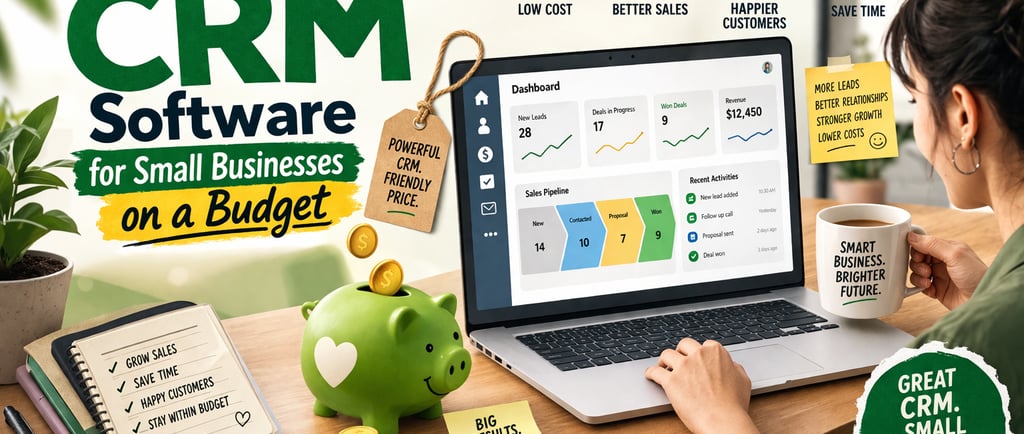
Software becomes valuable when it removes friction from ordinary work: following up, staying organized, reporting clearly, and handing tasks off without confusion. Affordable CRM Software for Small Businesses on a Budget is really a search for a better operating rhythm. Buyers in this category are usually not looking for abstract innovation; they want a platform that helps Small Businesses on a Budget work faster, stay organized, and keep standards high without creating extra admin work. In real teams, the winning tool is rarely the one with the largest feature grid. It is the one that makes daily tasks like ease of adoption, budget discipline, and simple reporting feel easier, clearer, and more repeatable.
For that reason, this article takes a practical view. Instead of treating every vendor as interchangeable, it focuses on where the leading options actually differ. In this space, names like HubSpot CRM, Zoho CRM, Pipedrive, and Freshsales often appear on shortlists because they solve the problem from different angles. Some emphasize cleaner setup. Some lean into stronger automation. Others win by keeping pricing, training, and maintenance manageable. The useful question is not which brand is loudest. It is which option removes the most friction from your current workflow while still leaving room for growth.
Common tools evaluated for this topic include HubSpot CRM, Zoho CRM, Pipedrive, and Freshsales. Reviewing a shortlist early helps you compare usability, data flow, and long-term fit before committing.
What this kind of buyer actually needs
The first filter is operational reality. Teams in this category usually care less about novelty and more about whether the platform supports ease of adoption, budget discipline, and simple reporting without adding unnecessary complexity. A good fit should strengthen contact context, client continuity, and handoff consistency. That means the interface should be understandable, routine tasks should be easy to repeat, and the reporting layer should help you see progress without needing a specialist every time something changes.
Which tools belong on the shortlist
HubSpot CRM usually makes the strongest first impression when a team wants a polished interface, structured follow-up, and room to add marketing or service layers later. The important point is not that it is universally best. It is that it matches a specific kind of buyer better than the rest of the field.
Zoho CRM tends to appeal to buyers who want strong value, a broad feature base, and enough customization to shape the system around their process without jumping to enterprise pricing. The important point is not that it is universally best. It is that it matches a specific kind of buyer better than the rest of the field.
Pipedrive often wins with sales-driven teams because its pipeline view keeps work visible, keeps next steps obvious, and reduces the chance that promising leads disappear into the gaps. The important point is not that it is universally best. It is that it matches a specific kind of buyer better than the rest of the field.
Freshsales is attractive when buyers want modern sales workflows, built-in communication tools, and automation that feels easier to deploy than a heavier enterprise stack. The important point is not that it is universally best. It is that it matches a specific kind of buyer better than the rest of the field.
Where the leading options separate themselves
HubSpot CRM usually makes the strongest first impression when a team wants a polished interface, structured follow-up, and room to add marketing or service layers later. The important point is not that it is universally best. It is that it matches a specific kind of buyer better than the rest of the field.
Zoho CRM tends to appeal to buyers who want strong value, a broad feature base, and enough customization to shape the system around their process without jumping to enterprise pricing. The important point is not that it is universally best. It is that it matches a specific kind of buyer better than the rest of the field.
Pipedrive often wins with sales-driven teams because its pipeline view keeps work visible, keeps next steps obvious, and reduces the chance that promising leads disappear into the gaps. The important point is not that it is universally best. It is that it matches a specific kind of buyer better than the rest of the field.
Freshsales is attractive when buyers want modern sales workflows, built-in communication tools, and automation that feels easier to deploy than a heavier enterprise stack. The important point is not that it is universally best. It is that it matches a specific kind of buyer better than the rest of the field.
The traps that make good tools feel bad
The most common mistake is buying for an imagined future while ignoring the present workflow. Teams then end up with a powerful system nobody fully adopts. Another mistake is assuming lower entry pricing automatically means better value. Total cost shows up later through seat expansion, add-ons, implementation time, or the friction of switching once bad fit becomes obvious. The safer path is to price the software against the labor it saves in ease of adoption and budget discipline and the clarity it creates for managers and operators.
How to pick the right fit without overbuying
A practical buying process keeps the comparison grounded. Take a real workflow from your business and run it through the shortlist. Create or import a small sample of real records. Ask the people who will use the tool every day to test how quickly they can complete common actions. Look closely at setup friction, searchability, notification logic, and whether the product naturally supports contact context, client continuity, and handoff consistency.
The best decision usually feels slightly boring in the best way: the software fits the team, the logic is easy to explain, and the next step is obvious. That kind of operational calm matters more than brand prestige because it is what turns software into an everyday advantage rather than another system to maintain.
Best matches by business type
Different business models reach different conclusions for good reasons. A smaller team often benefits most from clarity, quicker onboarding, and simpler administration. A more mature operation may accept a steeper learning curve in exchange for more control, stronger automation, or richer reporting. The right answer changes with team size, process maturity, and how central this software is to revenue or service delivery.
That is why the same headline can produce different winners for different readers. A solo operator may prioritize cost and speed. A growing team may prioritize structured workflows and cleaner handoffs. A cross-functional business may care more about integrations, permissions, and consistency across departments.
What to test before you commit
Once you get past marketing language, the real differences show up in day-to-day work. One product may reduce admin time because navigation is cleaner. Another may win because its automation builder is stronger or because its data model supports more edge cases. In this category, the most meaningful trade-offs usually sit around ease of adoption, budget discipline, and simple reporting, reporting depth, and how much effort it takes to keep the system tidy over time.
This is why buyers should compare one simple option, one balanced option, and one more ambitious option side by side. That kind of shortlist reveals whether your team values speed of adoption, richer control, or a stronger long-term platform. It also helps expose hidden costs such as training time, migration effort, or the need for extra tools to cover gaps.
Bottom line
For Small Businesses on a Budget, the strongest overall choice is usually the platform that balances clear usability with enough depth to support the next stage of growth. In many cases that means starting with the option that handles ease of adoption, budget discipline, and simple reporting well today and still leaves headroom for better automation, stronger reporting, or cleaner collaboration six to twelve months from now.
If two tools feel close, choose the one the team understands faster. Adoption is a real business advantage. A slightly less ambitious product that people actually use will beat a more complex platform that sits half-configured. The best software decision is the one that improves execution immediately and still feels sustainable as the business evolves.
FAQ and practical next steps
Which kind of team gets the most value from affordable crm software for small businesses on a budget? Usually it is the team that has outgrown improvised systems. When staff are chasing updates through email threads, spreadsheets, and chat messages, the right platform creates operational clarity quickly. The more repeatable the workflow becomes, the higher the return on a well-chosen system.
Should you choose the cheapest option? Not automatically. Low entry pricing can be attractive, but real value depends on adoption, reliability, and whether the product supports the next phase of growth. A slightly more expensive choice can easily be cheaper over twelve months if it saves labor, improves consistency, and avoids a painful migration.